The Frustrating Reality of Poor Indoor Connectivity
Picture this: You’re in an office, waiting for a quick phone call at 3 PM, only to be met with a faint cellular signal -just enough for a quick text to break the ice. Or maybe you’re in a corporate meeting, only to realize that every time you jump on Teams, the video freezes. Finally, you check your emails, only for the Wi-Fi to kick in and out unpredictably.
Sound familiar? Too many businesses face similar frustrations—reliable indoor connectivity is a necessity but constantly underdelivered. The problem isn’t the phones or laptops, but the signals. .
The Problem with Traditional Wi-Fi and VoWiFi
VoWiFi and standard indoor Wi-Fi are useful for general internet access, but they often come with limitations. Passwords and authentication landing pages for Wi-Fi access are an annoyance, maybe even more frustrating is that WiFi tends to have security vulnerabilities, even with the latest and greatest version. And when it comes to voice calls, the quality can become inconsistent or require extra hardware like external antennas, repeaters or a swarm of access points —what was supposed to be a lightweight deployment now require heavy infrastructure lifts to resolve consistency.
But there’s a better, smarter way: indoor 5G small cells. At first glance, they’re the technical successor to older LTE-based small cell solutions and built to deliver the same seamless, mobile-grade connectivity inside buildings regardless of outdoor signal quality but with modern capacity. Today we are not limited to DSL, we have fiber and that should be matched with 5G.
What Are Small Cells, and Why Are They Game-Changers?
Designed in the same way as outdoor cell towers but miniaturized into one sleek unit, indoor small cells pack all the key components:
- Baseband processing
- Radio frequency (RF) components
- Built-in antennas
Here’s the magic: they connect directly to your internet socket via Ethernet, providing near-institutional-grade coverage in a compact package.
Where Can They Be Deployed?
Small cells are versatile solutions, tailored to many businesses:
- Small businesses with offices or home offices (failsafe for remote employees)
- Residential end-users with limited or inconsistent mobile networks
- Public facilities like retail, coffee shops, local surgeries, strip malls.
- Commercial facilities warehouses, factories, etc.
Even a mid-sized company like this manufacturing one in a rural area — a 37-person business with field teams who need constant connectivity - benefitted from a two Pico small cell installation that turned poor indoor signal coverage into unbreakable call quality and video reliability.
Why Small Cells Still Have an Edge Over Competitors
The industry offers alternatives like Wi-Fi (VoWiFi), repeaters. Here’s the key difference:
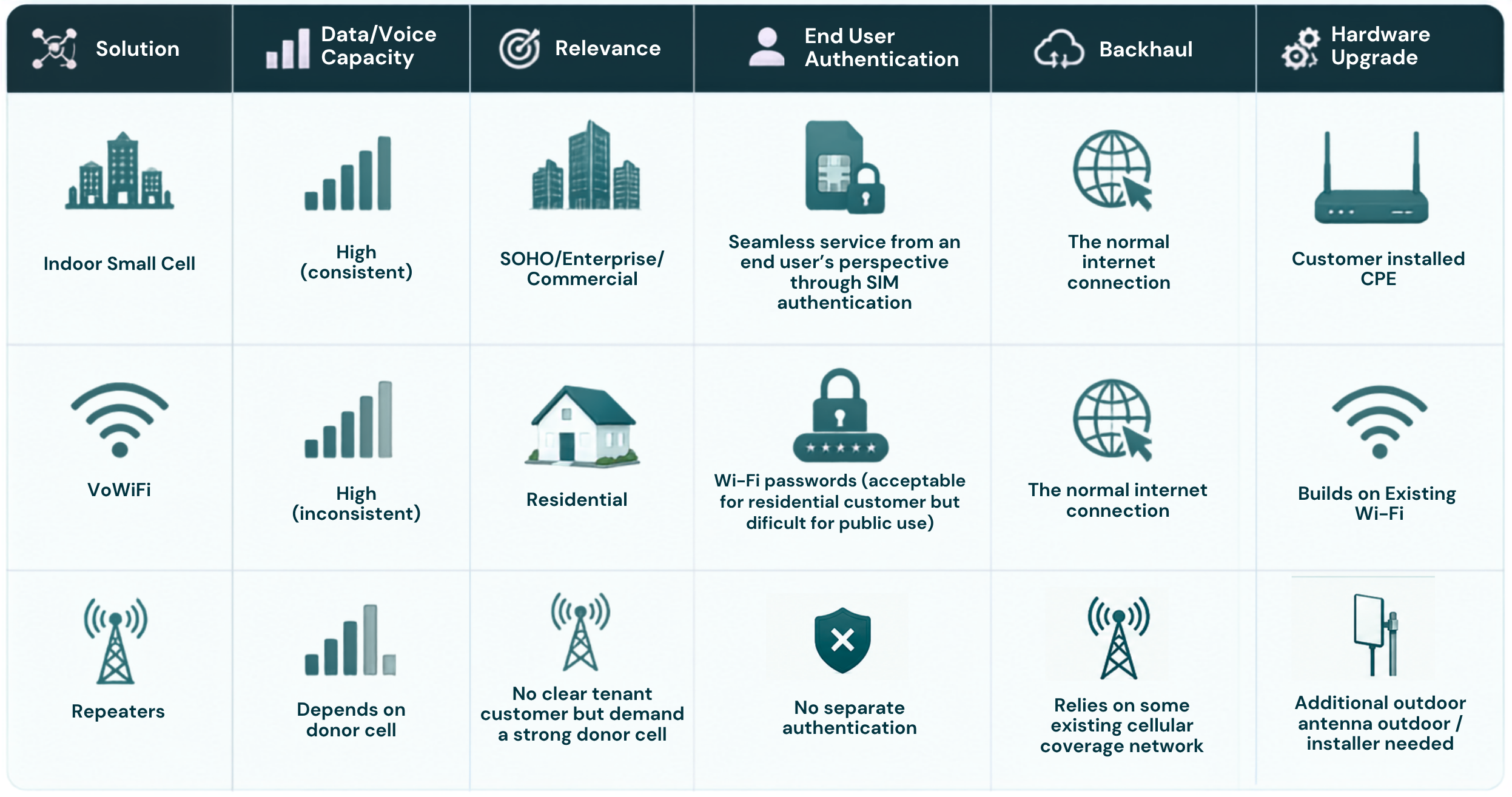
VoWiFi vs. Indoor Small Cells – When One Wins
The choice often depends on your setup:
- Family homes: VoWiFi is convenient - it leverages existing Wi-Fi without needing extra hardware (but comes with the inconvenience Wi-Fi passwords and flaky coverage and handovers to the mobile network).
- SOHO, banks, hospitals, logistics centers: Small cells win in reliability, security, and scalability - their seamless SIM-based authentication makes them ideal for public or mixed-use environments. For the end-user there is no difference from the normal mobile service and this spot service, except that good coverage is provided with the small cell.
Why the Industry Is Switching to 4G+5G Small Cells
5G is the new norm. End users expect 5G coverage, yet not every one change. In addition for better or worse, some small cell LTE chipsets reached the end of life; a new brew of small cells now support the next generation of 4G+5G indoor networks has come to market. It is not just a 5G SA small cell that is required, one need to support all 4G devices still in operation and NSA 4G+5G.
And while voice-only needs aren’t heavy on bandwidth requirement, they are essential for service continuity. Other use case such as interactive video calls, IoT (e.g., real-time monitoring in factories), or smart workflow devices or just plain voice calls all require low latency, high speed but most of call CONSISTENT service.
VoWiFi is an alternative choice as long as the coverage area is small and the users are few; however, it’s far less mobile: it tends to fail indoors due to signal interference (common in large corporate campuses where the distances are large as well as in homes where the router competes with all the other routers in the neighborhood).
On the other hand, a reliable small cell network means self-installed box, stronger security riding on the back of existing internet access and the ability to create reliable coverage where there was no coverage before.
Real-World Impact: The Hidden Heroes of Customer Experience
While small cells themselves aren’t flashy, they are a powerful enabler for seamless connectivity. For service providers trying to offer their clients the "extraordinary" customer experience we’ve heard so much about, a simple placement of Pico or Femto small cells will bring reliable service to a range of small, otherwise underserved users - from retail stores in inner cities to small factories where one lost call or inventory mismatch impacts entire workflows.
Imagine: a sales rep who couldn’t connect for an online client meeting—now no more. A medical care facility with multiple emergencies requiring real-time coordination—now everyone can stay connected when they need to.
In short: Indoor small cells aren’t just a technology. They're an intelligent solution meant to solve what no other system truly can.
The Bottom Line: Should You Choose This Solution?
So, what does this mean for the future of connected communications? With increasing reliance on video calls, data analytics, and seamless mobile experiences, businesses are no longer willing to cut costs at the expense of connectivity. When you compare small cells to the risks and constraints of Wi-Fi-based alternatives, Small Cells are clear winners for use cases that need reliability, seamless service access, and no security risks from poor Wi-Fi encryption schemas.
If you are thinking of deploying any kind of office or facility network - where mobile calls and reliable video communication are important—indoor small cells are the smarter investment. They are the best way of bridging the gap of traditional wireless solutions when staying connected can change everything.
Frequently Asked Questions
1. What is an indoor small cell?
An indoor small cell is a compact cellular base station that extends 4G and 5G mobile coverage inside buildings. It connects to a standard broadband or fiber internet connection through Ethernet and provides licensed-spectrum cellular coverage with seamless SIM authentication.
2. How is a small cell different from Wi-Fi?
Wi-Fi provides local wireless internet access, while a small cell delivers carrier-grade mobile network coverage. Small cells allow users to connect using their mobile subscription without logging into a Wi-Fi network, providing more consistent mobility, security, and voice quality.
3. Do indoor small cells replace Wi-Fi?
No. Small cells and Wi-Fi are complementary technologies. Wi-Fi remains ideal for general internet access, while indoor small cells are designed to deliver reliable mobile voice and data services, particularly in environments where cellular coverage is weak or Wi-Fi calling is inconsistent.
4. When should a business consider deploying indoor small cells?
Businesses should consider indoor small cells when they experience poor indoor mobile coverage, dropped calls, unreliable video meetings, or when employees and visitors depend heavily on mobile connectivity for business-critical applications.
5. Can small cells support both 4G and 5G devices?
Yes. Modern indoor small cells typically support both LTE (4G) and 5G, allowing operators to serve existing LTE devices while providing a migration path toward full 5G deployments, including Non-Standalone (NSA) and Standalone (SA) architectures.
6. Are indoor small cells difficult to install?
Not usually. Many pico and femto small cells are plug-and-play devices that connect to an existing Ethernet port and broadband connection. This significantly reduces deployment complexity compared to traditional Distributed Antenna Systems (DAS).
7. Are indoor small cells more secure than public Wi-Fi?
Yes. Small cells use SIM-based authentication over licensed cellular spectrum, eliminating the need for public Wi-Fi passwords and reducing exposure to many of the security risks associated with shared wireless networks.
8. What types of businesses benefit most from indoor small cells?
Indoor small cells are ideal for offices, manufacturing facilities, warehouses, healthcare centers, retail stores, hotels, educational campuses, banks, and other commercial buildings where reliable indoor cellular coverage is essential.
9. Can indoor small cells improve voice call quality?
Absolutely. Because users connect directly to the mobile network instead of relying on Wi-Fi Calling, indoor small cells provide more stable voice connections, fewer dropped calls, and smoother mobility throughout the building.
10. How do indoor small cells improve the customer experience?
Reliable connectivity enables uninterrupted voice calls, video conferencing, mobile applications, and IoT services. This improves employee productivity, customer satisfaction, and operational efficiency while reducing connectivity-related disruptions.
Comba Small Cell Solution
|
|
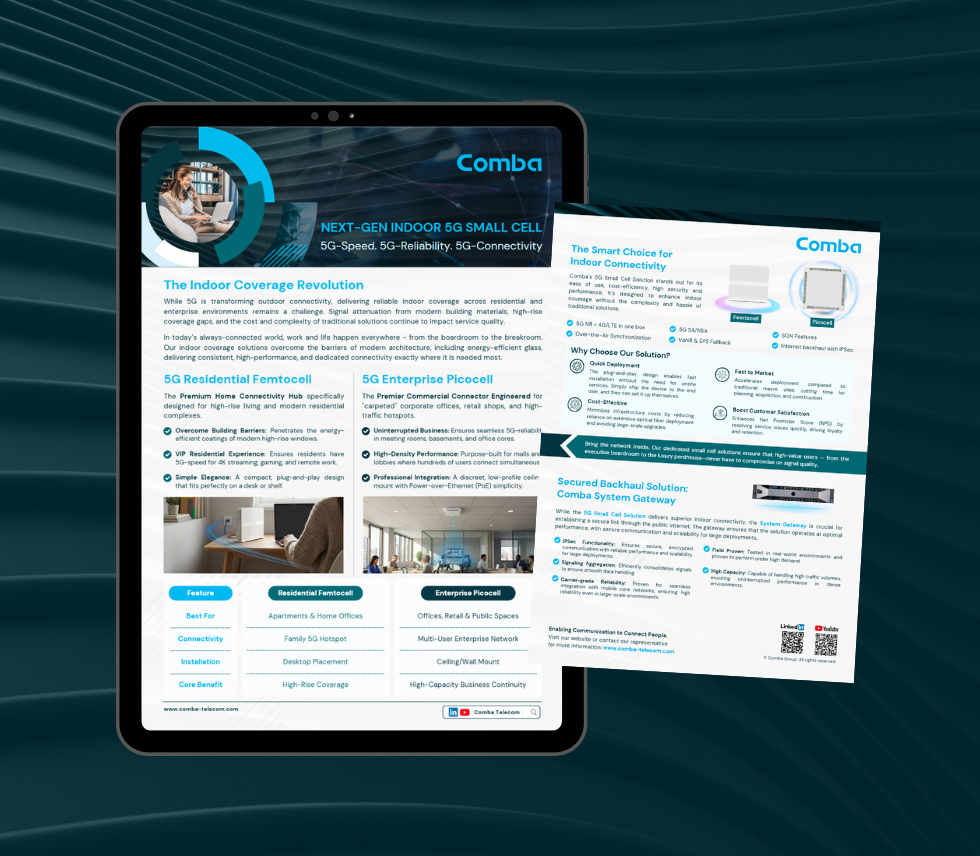
➡️ 5G Indoor Coverage with Comba Small Cell Solutions: Download the Brochure Here |