According to GSMA, around 70% of mobile use now takes place indoors - yet the right indoor coverage solution isn't the same for every building. Here's how to choose.
Enterprise decision-makers, property managers, and mobile network operators are asking the same question more frequently than ever: which indoor wireless technology actually fits our building? The answer depends on your building's size, the number of operators you need to support, your budget, and how fast you need to deploy.
The result is familiar to most enterprises: dropped calls, slow data speeds, and frustrated users.
To solve this, organizations typically evaluate three technologies:
- Digital Repeaters
- Distributed Antenna Systems (DAS)
- Small Cells
Each approach has its own advantages, trade-offs, and ideal deployment scenarios. The right choice depends on your building size, performance requirements, budget, and business objectives.
In this article, we compare these three technologies and explain how Comba Telecom offers solutions across all categories to help customers design the most effective indoor wireless strategy.
Why Indoor 5G Coverage Is More Challenging Than Ever
While 5G enables faster speeds and lower latency, its higher frequencies have reduced building penetration compared with legacy networks. Common obstacles include:
- Concrete and steel structures
- Energy-efficient coated glass
- Underground areas
- Dense office layouts
- High user concentration
For enterprises, poor indoor coverage impacts:
- Employee productivity
- Tenant satisfaction
- Customer experience
- IoT connectivity
- Critical communications
That is why selecting the right indoor coverage architecture is a strategic decision rather than simply a technical one.
Option 1: Digital Repeaters
A digital repeater captures an existing outdoor cellular signal, amplifies selected frequency bands, and redistributes coverage indoors.
Best For
- Small to medium-sized buildings
- Areas with good outdoor donor signal
- Fast and cost-effective deployments
- Coverage-focused projects
Advantages
- Lower CAPEX than DAS or small cells
- Minimal infrastructure requirements
- Rapid installation
- Multi-band and multi-operator support
- Secure remote management
Comba Solution: mPico and mPico Max
Comba’s mPico portfolio includes compact enterprise-grade digital repeaters designed for indoor coverage.
The new mPico Max supports up to five frequency bands simultaneously and enables multi-operator deployments in a single unit, making it particularly suitable for neutral host environments.
Key features include:
- Cell-ID and PLMN-ID locking
- Oscillation and isolation detection
- Remote management
- Uplink muting for noise minimization
- Battery backup for monitoring during power outages
Option 2: Distributed Antenna System (DAS)
A DAS distributes RF signals from one or more signal sources through a network of antennas installed throughout a building.
Best For
- Large buildings and campuses
- Airports and stadiums
- Hospitals
- Transportation hubs
- Mission-critical environments
Advantages
- Highly scalable
- Excellent coverage consistency
- Supports multiple operators
- Handles large venues and complex structures
Comba Solution: DAS Portfolio
Comba offers a comprehensive ComFlex DAS solution, including active and passive systems that support multi-operator and multi-band environments across enterprise and public venues.
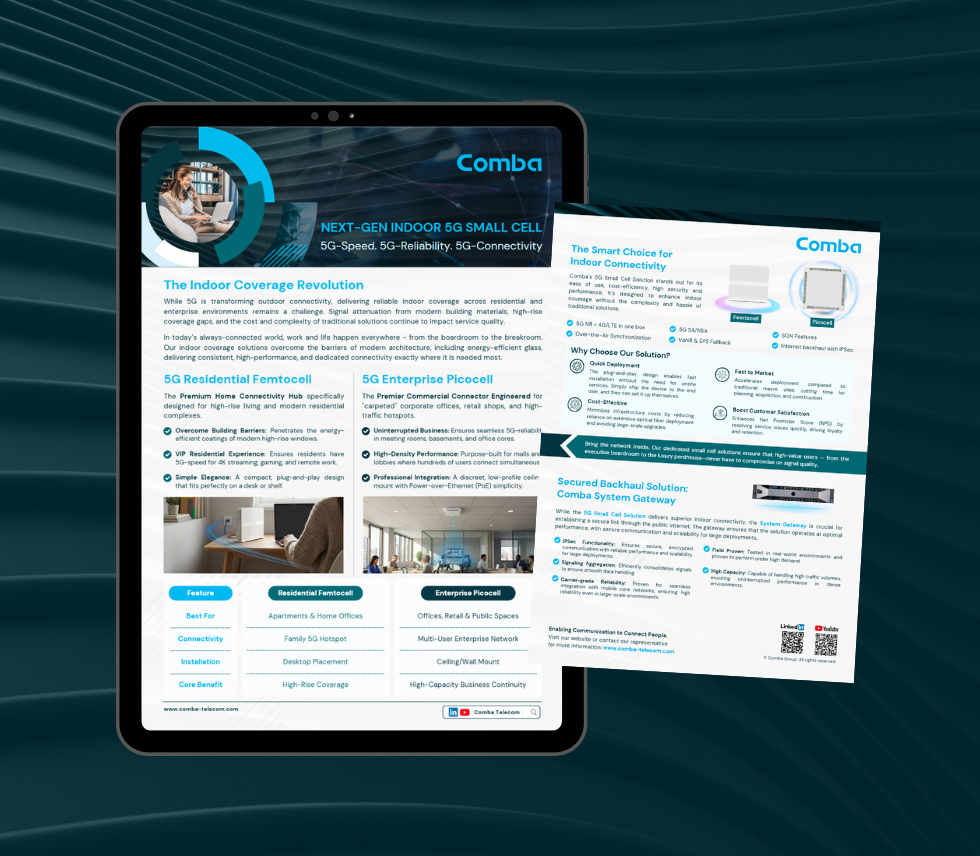
Option 3: Small Cells
Small cells are low-power radio nodes connected to the operator core network or an enterprise network to provide both coverage and additional capacity.
Best For
- High-density environments
- Capacity-constrained locations
- Private and dedicated network use cases
Advantages
- Adds new radio capacity
- Strong indoor performance
- Supports advanced 5G services
Comba Solution: Small Cell and Open RAN Solutions
Comba provides small cell and Open RAN-based solutions that support enterprise and operator deployments requiring both coverage and capacity.
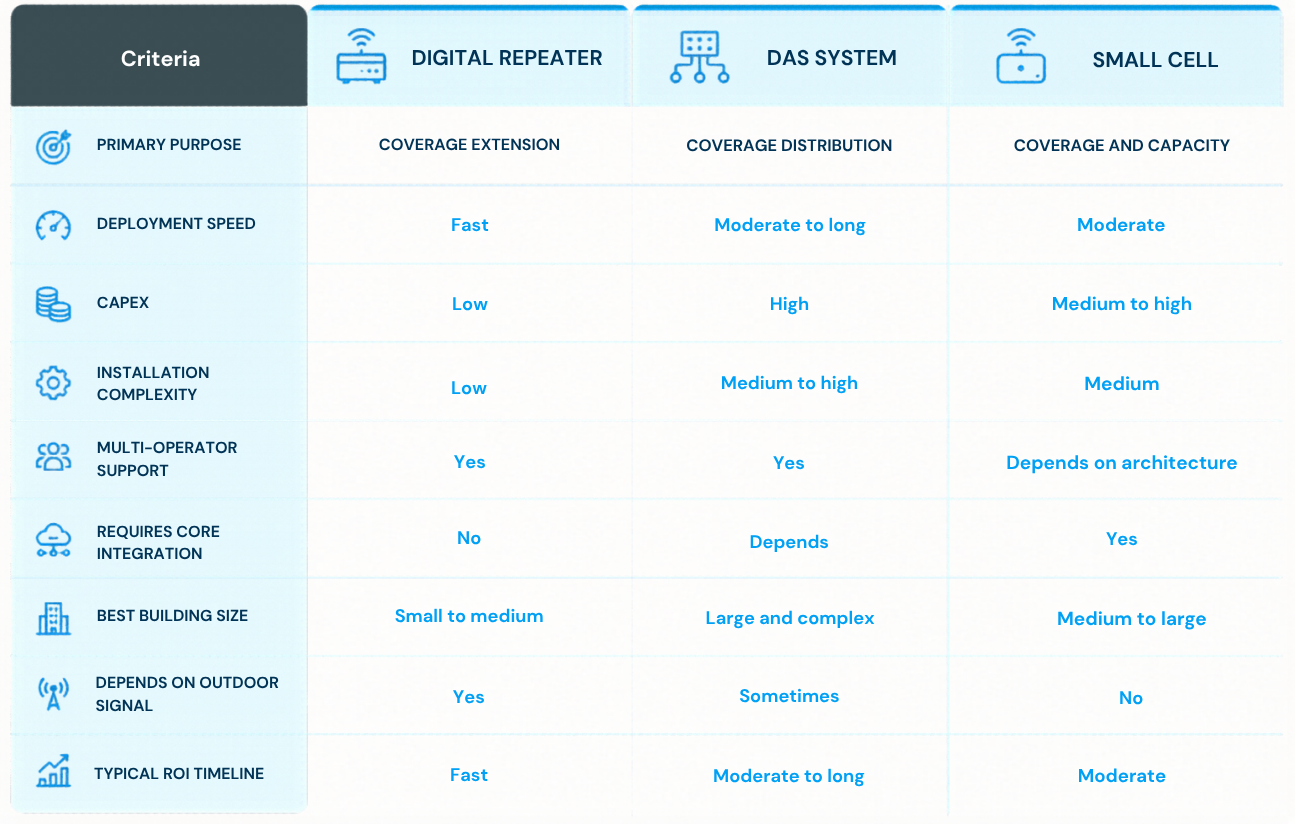
Repeater vs DAS vs Small Cell Comparison
Which Indoor 5G Solution Is Best?
There is no universal answer. The best solution depends on your specific use case.
Choose a Digital Repeater If:
- Outdoor signal is available
- You need a cost-effective solution
- Deployment speed is important
- Your objective is to improve coverage
Choose DAS If:
- The venue is large or architecturally complex
- Multiple operators must be supported at scale
- Long-term infrastructure investment is justified
Choose Small Cells If:
- Capacity is the primary concern
- Advanced enterprise applications require dedicated performance
- Integration with network infrastructure is acceptable
The Real-World Approach: Hybrid Architectures
In practice, many enterprises combine multiple technologies.
For example:
- Repeaters for office floors
- DAS for common areas
- Small cells for high-density conference zones
Because Comba offers all three solution categories, customers can select the architecture that best aligns with their technical and financial requirements rather than forcing a one-size-fits-all approach.
Why Enterprises Choose Comba for Mobile Coverage
Comba Telecom is a global wireless solutions provider with extensive experience in indoor and outdoor network infrastructure.
Comba’s portfolio includes:
- mPico digital repeaters
- DAS solutions
- Small cells
- Open RAN platforms
- BSA Antennas and RF components
- Network management systems
This end-to-end capability enables operators, system integrators, and enterprises to design scalable indoor coverage solutions with a lower total cost of ownership.
Sources: GSMA Mobile Economy 2024 | MarketsandMarkets Indoor 5G Market Report 2025–2030 | Persistence Market Research Network Repeaters 2026–2033 | Wireless Infrastructure Association Industry Report 2025
Frequently Asked Questions
What is the most cost-effective indoor 5G solution?
In buildings with a strong donor signal, digital repeaters are often the most economical option.
Can one solution support multiple operators?
Yes. Comba’s mPico Max and DAS solutions are designed for multi-operator deployments.
Is DAS always better than a repeater?
Not necessarily. DAS is ideal for large, complex venues, but repeaters can provide a faster and lower-cost solution for many enterprise environments.
Do small cells replace DAS?
Small cells can complement or replace DAS in some scenarios, particularly when additional capacity is required.
MORE RESOURCES
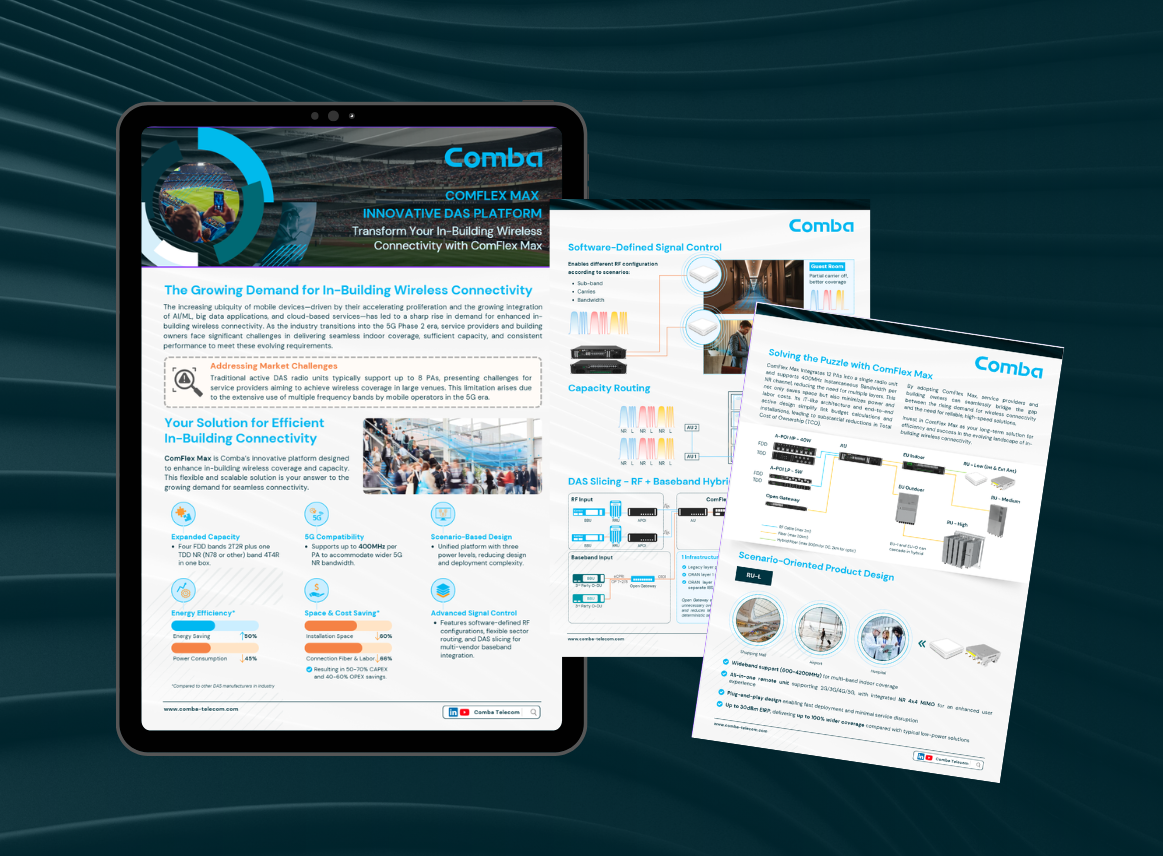 |
➡️ Learn more about Comba's DAS ComFlex: Click Here |
|
|
➡️ 5G Indoor Coverage with Comba Small Cell Solutions: Click Here for more information |